Can AI Actually Analyze Your Skin? What the Research Says
⚡ The 30-Second Version
- ✓AI skin analysis apps and in-store scanners claim to read your skin (pores, pigmentation, acne severity) and recommend a personalized routine — but the underlying accuracy research is more limited than the marketing implies.
- ✓A validated AI acne-grading algorithm, trained on nearly 6,000 dermatologist-graded images, matched dermatologist grading with 68% accuracy — real, but well short of diagnostic-grade reliability.
- ✓A separate 2022 study using a two-stage detection-then-grading pipeline reached 85% mean accuracy for severity grading against a clinical scale — but under controlled, standardized photo conditions, not typical selfie lighting.
- ✓Documented limitation worth knowing: broader reviews of AI skin-analysis tools found accuracy declines as skin tone darkens, reflecting training-data bias — a real equity gap in this technology, not a footnote.
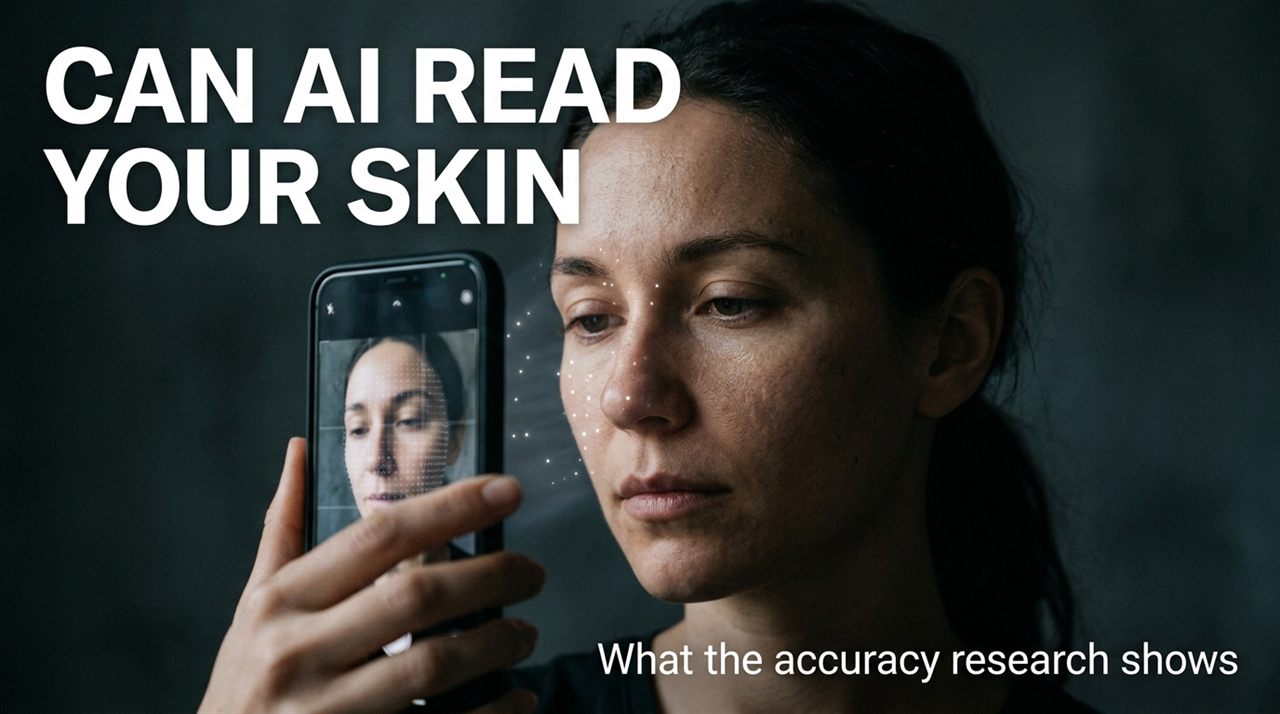
Point your phone at your face, and an app will tell you your pore size score, your pigmentation percentile, and exactly which serum you 'need.' AI-powered skin analysis — in apps, in-store kiosks, and dedicated scanning devices — has become a standard part of the personalization pitch in 2026 skincare retail. The pitch implies dermatologist-level precision. The actual accuracy research tells a more specific, more limited story.
The best validated accuracy data available
A 2019 study in Experimental Dermatology developed and tested an AI algorithm for grading acne severity from smartphone photographs, training it on 5,972 images from 1,072 patients, each graded by three dermatologists on a standardized severity scale. The final algorithm matched dermatologist grading with 68% accuracy. The researchers describe it as the first validated AI algorithm for smartphone-based acne grading — a genuinely meaningful research milestone, and also a clear data point that even a purpose-built, dermatologist-supervised model tops out well short of matching a human derm consistently.
A more optimistic — but more controlled — result
A 2022 study took a different, two-stage approach: first detecting individual acne lesions with a computer-vision model, then grading overall severity with a separate algorithm against a standard clinical scale. The lesion-detection stage was moderately accurate; the severity-grading stage reached 85% mean accuracy against the clinical scale. That's a notably better number than the 2019 study's 68%, but it's worth being precise about why: this study used standardized, controlled photo conditions, not the inconsistent lighting, angles, and camera quality of a typical bathroom-mirror selfie or a busy retail kiosk — the exact conditions most consumer AI skin scanners actually operate in.
The limitation that matters most
Broader reviews of AI-based skin analysis and skin-lesion detection tools have found a consistent pattern: diagnostic accuracy declines as Fitzpatrick skin type increases — meaning these tools perform measurably worse on darker skin tones. This tracks back to training data: most publicly available skin-image datasets skew toward lighter skin, so models trained on them inherit that imbalance. This isn't a minor caveat — it's a real equity gap, and it means the same AI skin-analysis tool can be meaningfully less reliable depending on who's using it, which most consumer-facing marketing doesn't disclose.
What this means when you actually use one
Treat AI skin-analysis output as a rough, generalized starting point for noticing patterns over time — not a diagnostic reading equivalent to a dermatologist's assessment, and not a tool that's necessarily been validated on skin like yours specifically. The controlled-condition studies showing 85% accuracy used standardized photography that most consumer tools don't replicate; the real-world accuracy of the app on your phone, under your bathroom lighting, is very likely lower than the number quoted in whatever research the company cites in its marketing.
The bottom line: AI skin analysis has real, published accuracy research behind it — 68 to 85% depending on the study and conditions — which is genuinely useful progress but well short of a diagnostic-grade tool, with a documented accuracy gap across skin tones that most apps don't mention. Useful for spotting trends in your own skin over time; not a replacement for an actual dermatologist visit if something looks concerning.
Heads up: links below are affiliate links — we may earn a small commission at no extra cost to you. Learn more.
📚 Sources & studies
- Seité S et al., Experimental Dermatology (2019) — Development and accuracy of an artificial intelligence algorithm for acne grading from smartphone photographs View study ↗
- Huynh QT et al., Diagnostics (2022) — Automatic Acne Object Detection and Acne Severity Grading Using Smartphone Images and Artificial Intelligence View study ↗
This article is for informational purposes only and is not medical advice. Skincare products affect individuals differently — consult a board-certified dermatologist for concerns about your skin.